MALMÖ UNIVERSITY LIBRARY | Exhibition
I am a Woman Worker - opening and lecture
Tuesday 3 November, 15:00 - 17:30
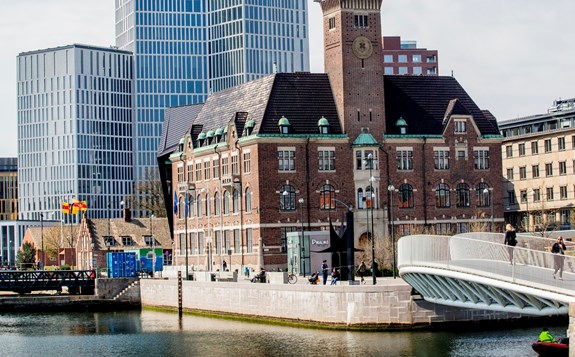
Malmö University, Orkanen Library, Nordenskiöldsgatan 10, 5th floor
15.00 Opening of the exhibition
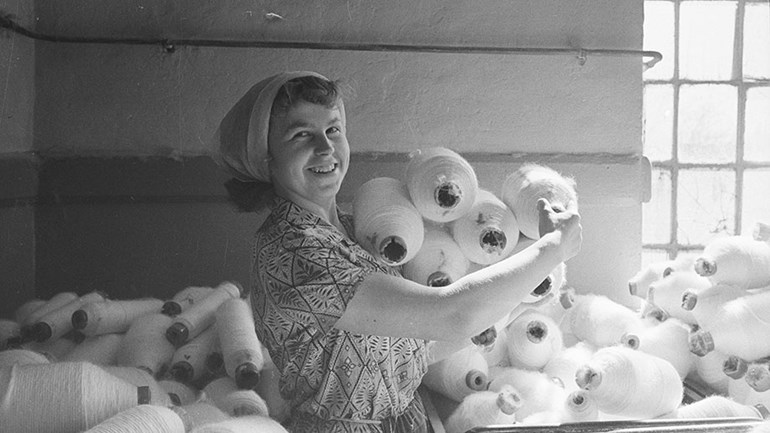
The exhibition "I am a Woman Worker" features photographs by Włodzimierz Parys (1928–1986) of female textile workers from the city of Łódź in Poland. Parys took the photographs during the 1960s and 1970s, seeking to capture the women in their everyday lives and at work. Many of the photographs are also very well composed and beautifully developed, which testifies to Parys’s skill as a photographer. The selection of photographs was made by Parys’s grandson, Artur Parys, who is a researcher at the University of Łódź.
16.15 Lecture by Artur Parys
(NOTE! The lecture will be held in Orkanen, room C127)
In 1969, Łódź photojournalist Włodzimierz Parys photographed women working at the Marchlewski Cotton Industry Plant, one of the city’s major textile factories. The presentation explores what everyday experiences of women’s labour reveal beyond official narratives of socialist production.
Drawing on a family archive of photographs rediscovered after fifty years, the presentation examines images taken in the factory’s production halls, workers’ homes and cultural settings. These are analysed alongside an oral-history interview with Jadwiga Pawłowska-Kwaśniak, who worked in the factory’s cultural institution and accompanied Parys during part of his documentation.
By combining photographs, oral history and photo elicitation, the presentation explores the material conditions of textile work, women’s domestic lives and the role of factory cultural activities in shaping working-class identity. It shows how these interconnected spaces offer a more nuanced understanding of women’s industrial experiences and the everyday realities often overlooked in official representations of the socialist woman worker.
About Artur Parys
Artur Parys holds degrees in Social Policy and Administration and a PhD in Social Sciences in the discipline of Economics and Finance. His academic interests focus on housing needs, local housing strategies and housing policies. His research also draws on documentary photography and his family’s photographic archive to explore urban space and urban sociology. He works at the Department of Investment and Real Estate at the University of Łódź, Poland.
The Everyday Work and Lives of Women Textile Workers
In 1969, the Łódź photojournalist Włodzimierz Parys photographed women employed at the Marchlewski Cotton Industry Plant, one of the major textile factories in the city. Reflecting on his practice, Parys stated: “I wanted to show these women as they were in their everyday lives, not on special occasions or posing for the photographer.” This article takes that statement as both a documentary credo and a historiographical problem: What dimensions of women’s labor become visible when working-class life is approached through everyday practices rather than through official narratives of socialist production?
Drawing on a family archive of photographs rediscovered after fifty years, the presentation analyzes images taken inside textile production halls and workers’ apartments connected to the factory. These photographs are read alongside a retrospective oral-history interview with Jadwiga Pawłowska-Kwaśniak, who worked in the factory’s cultural institution and accompanied Parys during part of his photographic documentation. The presentation also asks how visual sources and oral testimony can recover forms of female industrial experience that were often flattened in official representations of the socialist woman worker.
The analysis focuses on three interconnected spaces: the factory floor, where women’s bodies, gestures, work clothing, and proximity to machines reveal the material and embodied character of textile labor; the workers’ apartments, where domestic interiors show the living conditions that shaped women’s everyday lives beyond the workplace; and the institutional space of factory cultural life—exemplified by photographs of Pawłowska-Kwaśniak posed at the factory's main gate in the original folk costume of the Poltex dance ensemble, the plant's official troupe—which addressed workers’ cultural needs and connected work, memory, and working-class identity. This combination of visual sources, oral history, and photo elicitation makes it possible to reconstruct not only what the photographs depict but also the social relations, institutional practices, and everyday experiences that surrounded their creation. Rather than treating the factory floor as the sole site of working-class history, it reconstructs the everyday worlds of textile workers across interconnected spaces of production, domestic life, and factory-based cultural activity.
Doffeln, Strumpan & Trikåtan
The lecture series on Malmö’s textile industry is being held as part of the University Library’s exhibition "Doffeln, Strumpan & Trikåtan". You can visit the exhibition at the Orkanen Library until March 2027.
In collaboration with IMH, The Institute for Studies in Malmö’s History.