
We use cookies on this website. Cookies help us deliver the best experience on our website. Read about cookies.
-
- Education
- Education
- Find programmes and courses
- Applications and admissions
- Tuition fees
- Scholarships
- Exchange studies at Malmö University
- Study Guidance
-
- After admission
- After admission
- Moving to Malmö
- Pre-orientation
- Arrival guide
-
- About studies at Malmö University
- Why choose Malmö University
- Understanding university studies
- Connect with our students
On the page -
- Research
- Research
- Find researchers and research
-
- Doctoral studies
- Doctoral studies
- Doctoral courses
-
- Doctoral schools
- Doctoral schools
- Adaptation of urban space through sustainable regeneration
- Culturally Empowering Education through Language and Literature
- Doctoral school: DACHE
- Education, Learning and Globalisation
- Finding ways in a time of great future challenges (FinnFram)
- Swedish National Graduate School in Science and Technology Education Research
- Learning in Multicultural Societal Contexts
- Pedagogy and Vocational Skills
- Relevancing Mathematics and Science Education (RelMaS)
- Sustainable Movement Education
- The National Research School for Professionals in Social Services
- Research subjects
-
- Research centres
- Research centres
- Biofilms Research Centre for Biointerfaces
-
- Citizen Health
- Citizen Health
- Kids in Action
- Imagining and Co-Creating Futures
- Institute for Urban Research
- Malmö Institute for Migration Studies
- Literacy and Inclusive Teaching
- Centre for Work Life Studies
- Sustainable Digitalisation Research Centre
- Centre for Sexology and Sexuality Studies
-
- Research publications
- Search for research publications in Diva
- Malmö University Press
- Research events
- Participate in a research study
On the page -
- Collaboration & Innovation
-
- Levels of collaboration
-
- Local collaboration
- Muvah
- Co-Create Malmö
- Regional collaboration
- National collaboration
-
- International collaboration
- UNIC
- Innovation
- Collaboration with students
-
- Collaborate with researchers
- Labs and facilities
- Culture collaboration
- Support Malmö University
- Alumni & Friends
- Malmö möts
On the page -
- About us
- About us
-
- Meet Malmö University
- The history of the University
- Malmö University in numbers
- Sustainability
-
- Management and organisation
-
- Faculty of Culture and Society
- Department of Global Political Studies
- School of Arts and Communication
- Department of Urban Studies
-
- Faculty of Education and Society
- Department of Childhood, Education and Society
- Department of Sport Sciences
- Department of Culture, Languages and Media
- Department of Natural Science, Mathematics and Society
- Department of Society, Culture and Identity
- Department of School Development and Leadership
- The Centre for Teaching and Learning (CAKL)
-
- Faculty of Technology and Society
- Department of Computer Science and Media Technology
- Department of Materials Science and Applied Mathematics
- Faculty of Odontology
- Management and decision-making paths
- Malmö University's strategy 2030
-
- Quality assurance work at the University
- Widened recruitment and participation
- University Dental Clinic
-
- Malmö Academic Choir and Orchestra
- Student work – video pieces
On the page -
On the page
Advancing the development of high-performance alloys
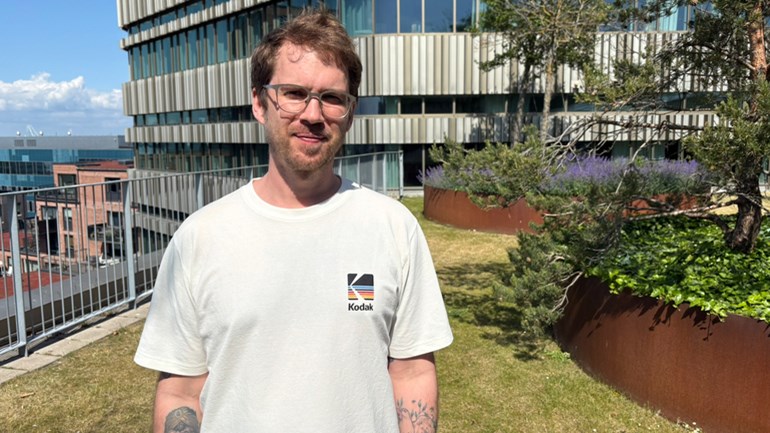
Mattias Tidefelt.
Enhancing our understanding of crystallisation in metallic glass through the study of various alloy systems has the potential to contribute to the green transition as well as provide high performing mechanical components, finds a Malmö University researcher.
Metallic glass is produced by rapidly cooling a liquid to a solid, amorphous state. ‘Amorphous’ means that the material’s structure is disordered and somewhat haphazard. It is this disorder that gives the alloy its unique properties, such as extremely high hardness and yield strength, as well as excellent corrosion resistance.
“These alloys are extremely sensitive to cooling rates, so very high cooling rates are required to achieve the desired glass structure. And the best way to understand what you want to avoid – namely crystallisation – is to study when glass metals crystallise during heating, which is a process that is easier to control,” explains Mattias Tidefelt, a PhD student at the Department of Materials Science and Applied Mathematics at Malmö University.
In his thesis, Temperature-induced phase evolution in metallic glasses, Tidefelt has primarily investigated alloys that are Zr-based (zirconium) and Fe-based (iron).
According to Tidefelt, both are alloys with interesting and promising commercial applications: Zr-based alloys are designed to be 3D-printed into larger glass components. And many Fe-based alloys have been developed to function as soft magnetic nanocomposites used in applications such as electric motors.
“Fe-based alloys are extremely interesting for the green transition, as the aim is to achieve more efficient and resource-efficient components. 3D printing of metallic components is also a method that is generally gaining ground. I know that both Saab and the company GKN Aerospace have interesting projects involving 3D printing of metals,” concludes Tidefelt.

Share Article