We use cookies on this website. Cookies help us deliver the best experience on our website. More about cookies

-
- Education
- Education
- Find programmes and courses
- Applications and admissions
- Tuition fees
- Scholarships
- Exchange studies at Malmö University
- Study Guidance
-
- After admission
- After admission
- Moving to Malmö
- Pre-orientation
- Arrival guide
-
- About studies at Malmö University
- About studies at Malmö University
- Why choose Malmö University
- Understanding university studies
- Connect with our students
On the page -
- Research
- Research
- Find researchers and research
-
- Doctoral studies
- Doctoral studies
- Doctoral courses
-
- Doctoral schools
- Doctoral schools
- Adaptation of urban space through sustainable regeneration
- Culturally Empowering Education through Language and Literature
- Doctoral school: DACHE
- Education, Learning and Globalisation
- Finding ways in a time of great future challenges (FinnFram)
- Swedish National Graduate School in Science and Technology Education Research
- Learning in Multicultural Societal Contexts
- Pedagogy and Vocational Skills
- Relevancing Mathematics and Science Education (RelMaS)
- Sustainable Movement Education
- The National Research School for Professionals in Social Services
- Research subjects
-
- Research centres
- Research centres
-
- Biofilms Research Centre for Biointerfaces
- Biofilms Research Centre for Biointerfaces
- Water Science Lab
-
- Citizen Health
- Citizen Health
- Kids in Action
- Imagining and Co-Creating Futures
- Institute for Urban Research
- Malmö Institute for Migration Studies
- Literacy and Inclusive Teaching
- Centre for Work Life Studies
- Sustainable Digitalisation Research Centre
- Centre for Sexology and Sexuality Studies
-
- Research publications
- Research publications
- Search for research publications in Diva
- Malmö University Press
-
- Research in focus
- Research in focus
- Focus: In the classroom
- Focus: The Election 2026
- Focus: A future with AI
- Focus: Climate and society
- Focus: Peace, democracy and human rights
- Focus: The mouth
- Focus: Migration
- Focus: Elite Sport, Football and Supporter Culture
- Focus: Perspectives on Malmö
- Focus: Loneliness
- Research events
- Participate in a research study
On the page -
- Collaboration & Innovation
- Collaboration & Innovation
-
- Levels of collaboration
- Levels of collaboration
-
- Local collaboration
- Local collaboration
- Muvah
- Co-Create Malmö
- Regional collaboration
- National collaboration
-
- International collaboration
- International collaboration
- UNIC
- Innovation
- Collaboration with students
- Collaborate with researchers
- Culture collaboration
- Support Malmö University
On the page -
- About us
- About us
-
- Meet Malmö University
- Meet Malmö University
- The history of the University
- Malmö University in numbers
- Sustainability
-
- Management and organisation
- Management and organisation
-
- Faculty of Culture and Society
- Faculty of Culture and Society
- Department of Global Political Studies
- School of Arts and Communication
- Department of Urban Studies
-
- Faculty of Education and Society
- Faculty of Education and Society
- Department of Childhood, Education and Society
- Department of Sport Sciences
- Department of Culture, Languages and Media
- Department of Natural Science, Mathematics and Society
- Department of Society, Culture and Identity
- Department of School Development and Leadership
- The Centre for Teaching and Learning (CAKL)
- Knowledge Centre for Educational Health in Schools (PHIS)
-
- Faculty of Technology and Society
- Faculty of Technology and Society
- Department of Computer Science and Media Technology
- Department of Materials Science and Applied Mathematics
- Faculty of Odontology
- Management and decision-making paths
- Malmö University's strategy 2030
-
- Quality assurance work at the University
- Quality assurance work at the University
- Widened recruitment and participation
- University Dental Clinic
-
- Malmö Academic Choir and Orchestra
- Malmö Academic Choir and Orchestra
- Student work – video pieces
On the page -
- Contact
- Contact
- We help you with your questions
- Find your way around Malmö University
- Visit Malmö University
-
- News and press
- News and press
-
- Graphic manual
- Graphic manual
- Logo
- Colours
- Typography
- Visual language
- Film and live broadcasts
- Merchandise
- Supplier information and invoice management
- Whistleblowing
On the page
Female researchers honoured on Ada Lovelace Day
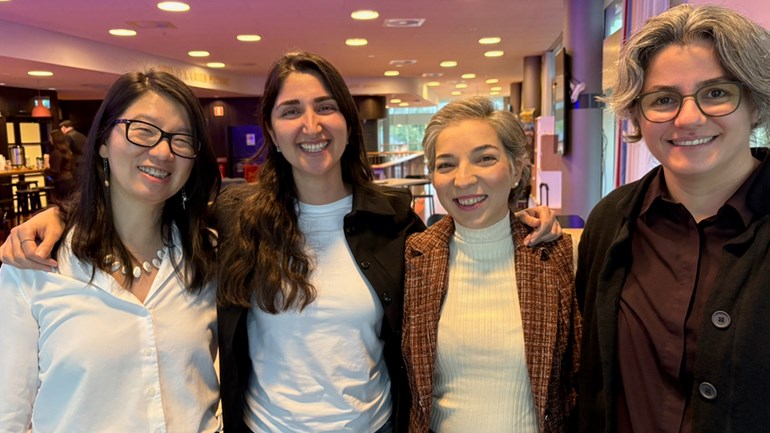
Yujing Li, Sally Bagheri, Asli P. Rhodin and Najmeh Abiri shared their experiences of working in the field of technology.
During Malmö University’s Annual Academic Celebration week, the Faculty of Technology and Society hosted an afternoon of inspiration, discussions and meetings with women working in technology and technical research.
Ada Lovelace Day is an international day that recognises women’s contributions to science, technology, engineering, and mathematics. Ada Lovelace (1815–1852) was a British mathematician and writer. Her notes are generally considered to contain the first algorithm intended to be processed by a machine, and she is therefore often described as the world’s first computer programmer.
Three women with different backgrounds and experiences in the field of technology spoke about their respective research journeys: Najmeh Abiri, senior lecturer at the Department of Computer Science and Media Technology, on her project to rapidly identify dangerous ticks using deep generative methods; Yujing Li, associate professor at the Department of Materials Science and Applied Mathematics, on her passionate interest in a healthy indoor environment; and Asli Rhodin, senior data scientist at Ericsson, on her winding journey from dreams of belly dancing to a PhD in atomic physics.
Sally Bagheri, a PhD student at the faculty, was the event’s compère.
“Celebrating women is, of course, a complex matter, but I hope that we will continue to celebrate this day in the future, regardless of whether women are at the centre of attention or not. For if there was one thing that Ada Lovelace embodied, it was precisely creativity and the ability to envisage solutions other than those that were possible in her time,” says Bagheri.

Share Article