Supercomputer reveals the secret of water
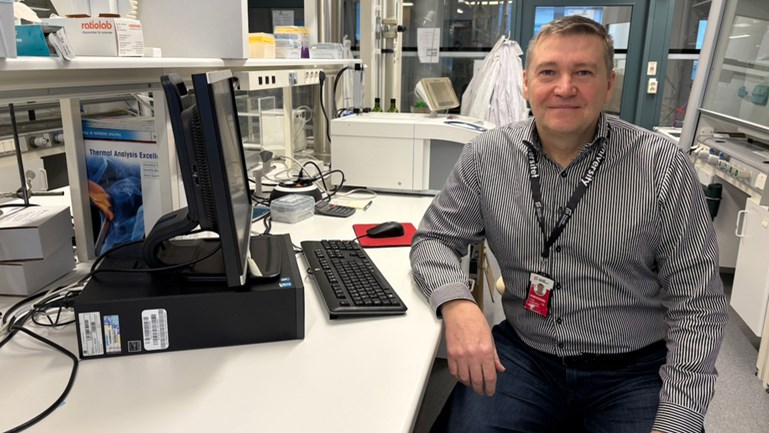
Vitaly Kocherbitov, professor at the Department of Biomedical Sciences at Malmö University.
Using supercomputer simulations, researcher Vitaly Kocherbitov has investigated how water behaves at extremely low temperatures. The results add another piece to the jigsaw of this yet unsolved mystery: what happens when water is cooled so rapidly that ice crystals do not have time to form.
Water researchers refer to this as ‘no man’s land’. This elusive temperature range lies between the point at which ice crystals form and the point at which water transitions to a more unstructured glassy phase – a transition which, in laboratory experiments, occurs at –137°C. Studying water within this range is extremely difficult, as it tends to crystallise before its properties can be measured.
Water is one of the most familiar substances in our everyday lives, but we still do not fully understand how it behaves.
Vitaly Kocherbitov
“Using molecular dynamics simulations, we can cool water extremely rapidly and avoid crystallisation. At such high cooling rates, the molecules do not have time to reorganise themselves quickly enough to maintain equilibrium. You could say that the water doesn’t quite keep up,” explains Kocherbitov, professor at the Department of Biomedical Sciences at Malmö University.
In his simulations, he has used 4,096 water molecules, which he has cooled much more rapidly than is possible in standard laboratory experiments. The results are presented in the article ‘Coupling between structural evolution and glass transition in supercooled water’, published in the journal, Scientific Reports.
Kocherbitov’s research focuses on two processes that take place when water is cooled: changes in its molecular structure and the dramatic slowing down of molecular motion, which eventually leads to the glass transition.
“An influential theory suggests that water contains two types of local molecular structures: one in which the molecules are more tightly packed and another with a more open structure. As the water cools, the balance between these changes. This explains many of water’s unusual properties,” says Kocherbitov.
However, at extremely high cooling rates in computer simulations, these two processes overlap, making it difficult to determine which effects are due to changes in molecular structure and which are caused by the glass transition. To solve this problem, Kocherbitov has developed a mathematical model that makes it possible to separate the respective contributions.
“Our model enables us to describe both processes together and understand how they influence one another,” he explains.
One field of research where this is highly relevant is cryopreservation, which involves freezing living cells, tissues, or biological material to extremely low temperatures in order to preserve them for long periods. Or the tantalising future scenario: successfully freezing a living human being and then thawing them out. To achieve this, crystallisation must be eliminated to prevent the cells from shattering into pieces.
“Water is one of the most familiar substances in our everyday lives, but we still do not fully understand how it behaves. With this research, we have taken another step towards solving the mystery,” adds Kocherbitov.